

The Brunette returns, pitchfork in hand
It's been a journey, and it's only just begun

Two years ago this month, I enrolled in a brain-retraining program1 to combat my autoimmune condition using neuroplasticity techniques. We used to think who you are is cemented in time, unchangeable, but now it’s clear we can rewire our brains for radically different attitudes and behaviors, and in my case, even medical health outcomes.
Head-injury victims can relearn motor functions even when those areas of the brain are traumatized. You’re continually conditioning your brain with dopamine hits to curate your life for public consumption on Substack—in a particular way, for more likes or comments. To learn to play an instrument, you must practice, another way to train your brain.
So neuroplasticity is science. I hope that doesn’t put you off after the onslaught of attempts over the past five years to condition you into believing that you should just shut off your brain and trust the experts.
I’m not asking you to do that. Far from it.

What I am asking you to do to is join me in this journey.
In the two years that I’ve been retraining my brain and actively using other interventions to treat an autoimmune condition, I’ve had to take up a pitchfork and dig through what was at the root of my illness: trauma.
I’m not using the t-word lightly.
Here’s the truth.
My biological father repeatedly sexually assaulted and raped me when I was just a little girl—too young to understand, comprehend, and process what he did to me. Not just my mother’s but every adult’s denial, avoidance, and enabling, neglectful acts perpetuated and exacerbated his crimes, compounding them and creating an environment of chronic trauma.
There’s a lot of shame attached to the crimes—and that’s what they are, prosecutable crimes as recognized by our justice system.
But I’ve heard that shame isn’t something human beings naturally feel; rather, it’s put there by other people’s reactions to whatever the thing is you’re made to feel ashamed about.
It doesn’t make logical sense for me to feel ashamed of the crimes committed against me. They happened to me—I was the victim, and as a mere child, I was at the mercy of the very adults who were supposed to protect me: I was utterly defenseless.
So why the shame?
No one wants to hear about heinous crimes committed against innocents. It’s “too triggering.” We look away, avoid, disengage, maybe even dissociate.
And that’s the last thing victims need.
The looking away, the avoidance—it’s what casts us all in shame.
As if the victim is the embodiment of the crime itself.
Almost as if she’s to blame for it.
It’s a terrible cliché these days to say you’re “breaking your silence,” but that’s what I’m doing here.
I’m breaking my silence so that I can breathe.
I’m breaking my silence to clear space for other victims to breathe, too. And in our shared breaths, we might feel less alone.
Less like victims and more like survivors. Maybe even thrivers. Is that a word? People who thrive in life.
🌳 How is trauma at the root?
In those moments when my father brutally attacked me, my psyche at ages five, six, seven, and so on could only cope.
Imagine the very person you would call for help is the one hurting you.
You know the phrase “coping strategy.” My brain, my glorious, brilliant brain, when faced with the horrendous, the incomprehensible—when staring into the face of evil itself—my brain came up with a whole suitcase full of coping strategies.
One of these was to make sure I was kept constantly alert for the next attack.
It could come at any moment.
Nowhere was safe: not my own bed, or home, or our family car.
No one could be trusted: not my own mother or grandparents, aunts, or uncles, or our neighbors, and not even the doctors at the military base where my father worked.
I learned to be hypervigilant.
My immune system learned to treat anything entering my body as a foreign invader.
This tracks, doesn’t it? If your own father can attack you, then anything can, and over a lifetime, that anything grows to include the food you might otherwise take sustenance and pleasure in eating, the flowers you admire in look and scent, the very air you breathe.
🧑🌾 Where we’ve been so far
I launched this Substack in late summer 2022 as an outlet for my experiences with city homesteading, which was itself borne out of a quest for the perfect autoimmune diet.
Through that work, I developed boss homesteading skills that are still with me and still valid. I tested and perfected them and shared them with you, my readers. I am now convinced that diet alone is not the answer for autoimmune conditions like mine and in fact, the wrong, restrictive diet can be part of the problem. But I continue to recommend the eating habits my guest authors and I have tackled at Brunette Gardens:
🚬 Eliminating nicotine and recreational drugs entirely and minimizing pharmaceuticals when possible
🧪 Avoiding processed food and food additives, thickeners, gums, and other lab-generated ingredients
🧁 Avoiding refined white sugar, along with alcohol and seed oils
🌾 Eating whole grains, legumes, and nuts and preparing them in time-honored ways to make them more digestible and nourishing
🐔 Gaining the vital nutrients that can only come from trusted, regenerative animal sources, whether meat, egg, or dairy, and including raw food and organs
🥗 Eating vegetables you gather from as close to the source as possible, whether your own garden or a local farmer’s, most often cooked or prepared using ancient fermentation techniques
My recommendations align with the new guidelines released today by the US Department of Health and Human Services. I’ve personally been hoping for this shift and applaud the Trump Administration for making it (though the cap on saturated fat still needs to be raised).
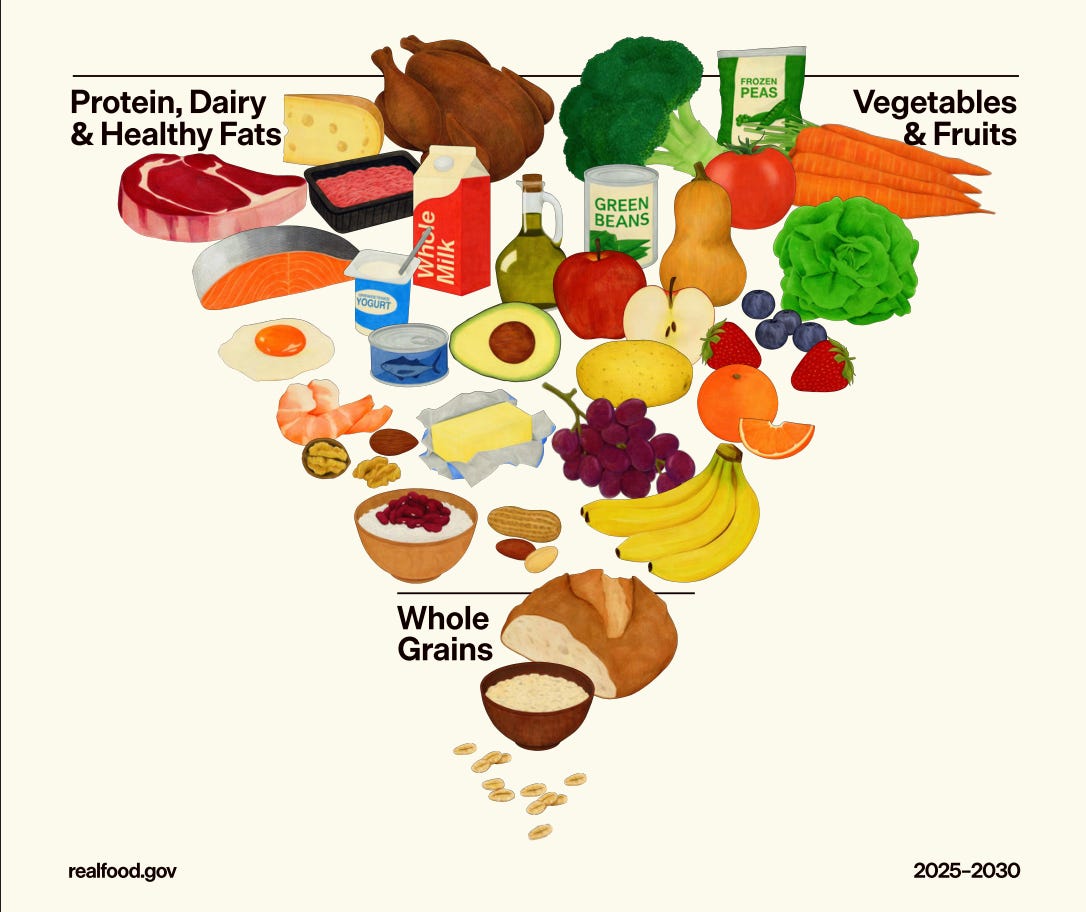
Think about this: If the food fed to an abused child is itself unhealthy or read by the body as a foreign invader because it contains chemicals and additives, the brain is in a way exhibiting cleverness in triggering a whole host of what we call sensitivity or autoimmune responses to it.
I realize this might be a bit confusing, the connection between autoimmune conditions and food sensitivities, trauma, neuroplasticity, child abuse, and diet and nutrition, with the homestead garden as a balm and salve overall. Let’s tug on the threads and unravel the mess together.
🔭 What’s ahead
Out of the 230-plus posts published here, the ones that seem to resonate best with readers are the stories that I felt the most nervous about, like this essay on trying to fill your empty nest with baby chicks or this one questioning the ability to homestead in late middle age.
During my break from this Substack over the past six months, I kept thinking about what’s vital to me. When the idea of sharing my writing makes me anxious, it’s because the topic is crucial. I feel it in my flesh and bones.
I pledge to write in that space. When my post shows up in your feed, you’ll know it’s worth reading because as a writer I’ve already shown up for you.
Are you with me?
If you join using the link, I might earn a small commission at no extra cost to you. Thank you for supporting my work to help others heal using neuroplasticity.
While I applaud the changes, there's still a lot of room for improvement in the new dietary guidelines: https://unsettledscience.substack.com/p/butter-is-not-back-the-broken-promise
Hitting 'publish' on this one is the scariest moment of my 35-year career. Heart palpitations...