

More than 50 percent of you know trauma
And half look to Jesus for guidance.

Over the past two weeks’ break from writing, I’ve been mulling over the results of my survey, especially this first question.
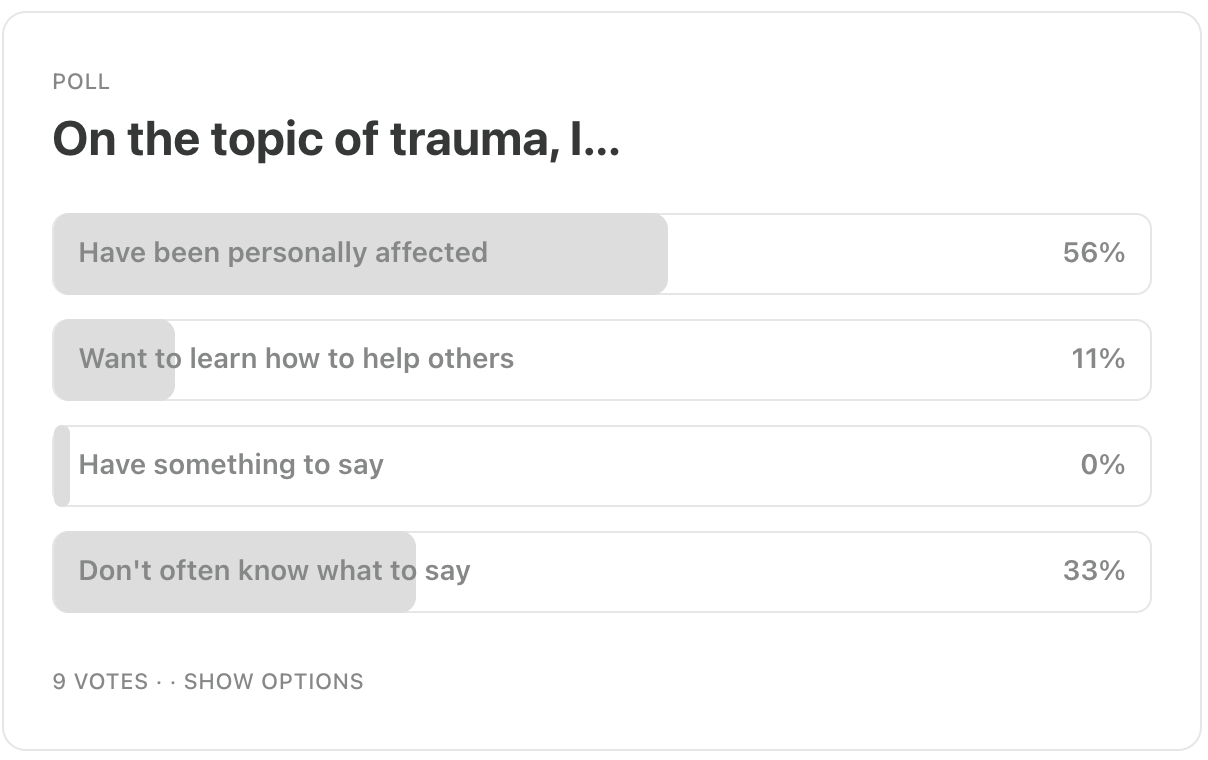
Of course there were only nine votes, and maybe the other 800+ people who read the post have not been personally affected by trauma. Maybe they just signed up for gardening tips and were annoyed that I was even asking the question.
But still. It’s something for me to think about, as your writer.
As I’ve mentioned, one of the most popular posts so far this year was the one I wrote about suicide.

My whole life, I’ve had to challenge myself on that topic.
My youngest brother, Jason, and I have actually argued about suicide as a right, and a valid decision. A therapist once told me to tell him, “No one’s ever come back from that decision to tell us it’s the right one.” She was very influenced by New Age gurus like Jack Kornfield and Pema Chödrön. Instead of offering any insights of her own, from her own practice with actual people who’d contemplated suicide, she was always quoting these gurus, or recommending their books.
“No one’s ever come back to tell us it’s the wrong one, either,” Jason retorted. Touché, right?
That’s the problem with New Age thinking: It’s often circular. Like, “you are perfect as you are” but “when we resist change, it’s called suffering.”
This particular therapist’s office looked as if a gay pride parade had thrown up all over it, and, as the New Age gurus like to say, there are no coincidences. Here’s a quote from Yellowstone’s Beth Dutton that resonated with me far more than any of those stupidly useless bromides:
I am the rock therapists break themselves against.
Thinking about a majority of survey responders being personally touched by trauma in light of the popularity of my suicide post put me in the mind of this Jordan Peterson talk on Genesis. About an hour into the thing, he addresses suicide, by way of suffering. I’ve started the video right where he shifts into talking about Goethe’s Faust, as a springboard into suicide.
“You have to be pushed a long way, generally speaking,” Peterson says, “before you’ll actually commit suicide.” As someone who once drafted a suicide manifesto, I felt appropriately challenged by his argument against an end to it all, signing off for a final time, calling it kaput:
You have to be in very, very desperate straits, but your answer under those conditions is that being is such that it would be better if it had never been. I think that’s a terribly philosophy… I think what happens if you act it out is that you make the very things that led you to despair far worse […] the answer can’t be to produce more suffering. (my emphasis)
That resonated with me a great deal, the argument that the antidote to suffering can’t be more suffering. Through the rest of the talk, Peterson gets to a better counter to the suicide solution: to actively work against the world’s suffering.
That hits right at my motivation for writing about trauma in the first place even though of course I’m supposed to stay in my lane, right, and stick to writing about plants. It’s my answer to the deep pain of parental betrayal and to the suffering that betrayal caused me.
I used to think the best revenge when you’ve been horribly wronged is a life well-lived. But this was never enough, somehow. Chasing success and material comforts wasn’t sufficient to work against my family trauma. You can’t fill the pit of despair with foodie experiences or a tech job with a view of the Olympic mountains from your office desk.
I’ve had to redefine a life well lived as one that counters the pain in the world through love and connection instead. That starts with your first circle, your family—maybe not the one you were born into, if that’s the source of your trauma as it was for me, but the one you create, the one you make yourself.
I’m now extending that sphere outward in the same spirit Peterson argues, to actively work against the suffering of children that carries into adulthood. I aim to use my God-given talents to help others heal the way I have, to learn from my experiences as both victim and survivor over more than half a century of handling the crimes committed against me when I had no control.
How do you work against the suffering in the world? Does gardening help you do that? Is gardening just for you—or do you share it with others?
If you’ll indulge me in another survey, I’d also like to know more about this suicide thing. Survey results are anonymous; there’s no way for me to tell which answer is yours; all I get is the same numerical results you see.
I would answer the above, “Sometimes.” Fortunately for me, I’ve never gone as far as to attempt it. I sympathize deeply with those who have, and with the loved ones who suffered the pain and loss of their choice.
If you were paying attention to my subhead on this post, you might be wondering about half of us looking to Jesus for guidance. That was from another survey question:
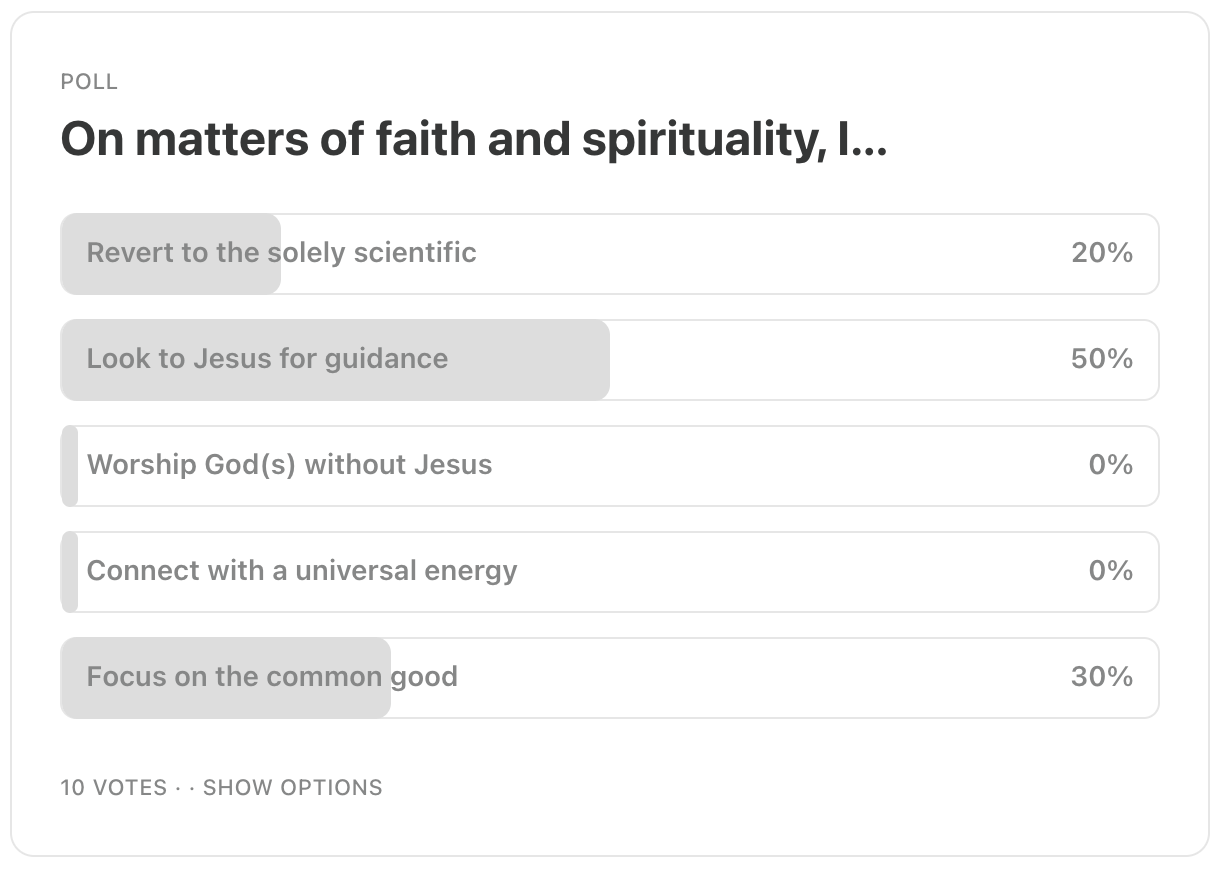
Have to say that result surprised me, even more than the trauma percentage. It’s encouraging, though, since my next two posts heavily reference the Bible. The first one is about the Genesis story of Joseph, and I’m really curious to see how you respond to it. Though written more than 3,500 years ago, Joseph’s tale exemplifies some of the best aspects of modern trauma psychology: resilience, healthy boundary setting, putting a name to the crimes, acknowledging victimization, reframing, and finally, finding meaning in human suffering.
Look for that post on June 11, as I’ve committed to a biweekly cadence for the rest of the year. I also hope you’ll join me in the chat in the meantime for a casual conversation.

You can always ask me for advice in the chat, too. As a self-taught gardening know-it-all, I feel a sense of hard-won pride when people ask me for advice, and that’s already happened twice this spring. First, my neighbor asked me what she could plant in the shade near her house, so I turned her onto our native Hydrangea arborescens, which is hardier than the typical hydrangeas sold at big-box stores and does a better job of feeding insects and wildlife. Then the aforementioned brother Jason sought my advice on what to plant in the southeast corner of his home, where he needs a hardy plant to trail over a brick planter. I offered another native, purple poppy mallow.
For a reminder of the Brunette Gardens membership tiers or to share what this is all about with friends, check out the welcome page.

What’s your take on the survey results?
It took me a long time (decades) to understand the effects of domestic abuse on my personality and behaviour. Gardening was definitely part of that healing process but I find it less necessary now. I suppose it could be about control - while gardening can and does go awry due to weather, pests, etc., you are creating something and changing a piece of land into something that reflects you. That's taking back control. It's not the answer though, just a stopgap which helps on the healing journey. St Teresa of Avila said there are many paths and we all walk different ways to God. A good thought, I think.
Not sure I ever saw your earlier survey. I would have answered it, I usually do if they seem legitimate. And I would have answered yes to all of the questions, if that was allowed. Though not a trauma like yours to #1.
I also came for the gardening, but am looking forward to your upcoming columns. Thanks.