

If you want to die
A hotline might not help, but a buddy who's been there can.

One night I was yet again awake at 3 am and full of dark thoughts.
When you’ve been the victim of heinous crimes that severely traumatize you, this can happen even after years of therapy. The 3 am brain gives you the raw version of your psyche, the part of you who took the burden of the traumatic experience, walling it off from the rest of you, the “normal” part. The 3 am brain doesn’t give a shit that you need your sleep in order to get up and do mundane things in the world; it’s still trying to cope with that heinous crime.
I got out of bed, which you’re supposed to do to counteract insomnia, teaching your brain that the bed is not a place to lie awake with spiraling thoughts. I drank some water, stared at the moon and stars in the dark sky, and then cued up a somatic meditation.
Forty minutes later, I was still spiraling.
Logically, I know suicide is not the answer. I’ve made all the arguments to others in this position. The one I’ve landed on most frequently says to find the small things in life that make it worth living until you can get to the bigger, more rewarding things. You start with the vibration from your cat’s purr when he’s snuggled up to your chest. Eventually that gets you to the feel of your husband’s hand in yours.
But the 3 am brain can’t hear any of that. It makes a compelling case for the opposite, and the body supports that thesis with both physical and emotional pain. Suicide seems like the only way to make all the pain just fucking stop.
Feeling desperate, I reached out for help from two sources: 1) my brother Jason, and when he didn’t at first respond, 2) a suicide hotline.
Which one do you think did me any good?
Black-pilled as I am these days, I was actually surprised by how bad the hotline sources were, both of them. First, the website link from Google took me here.
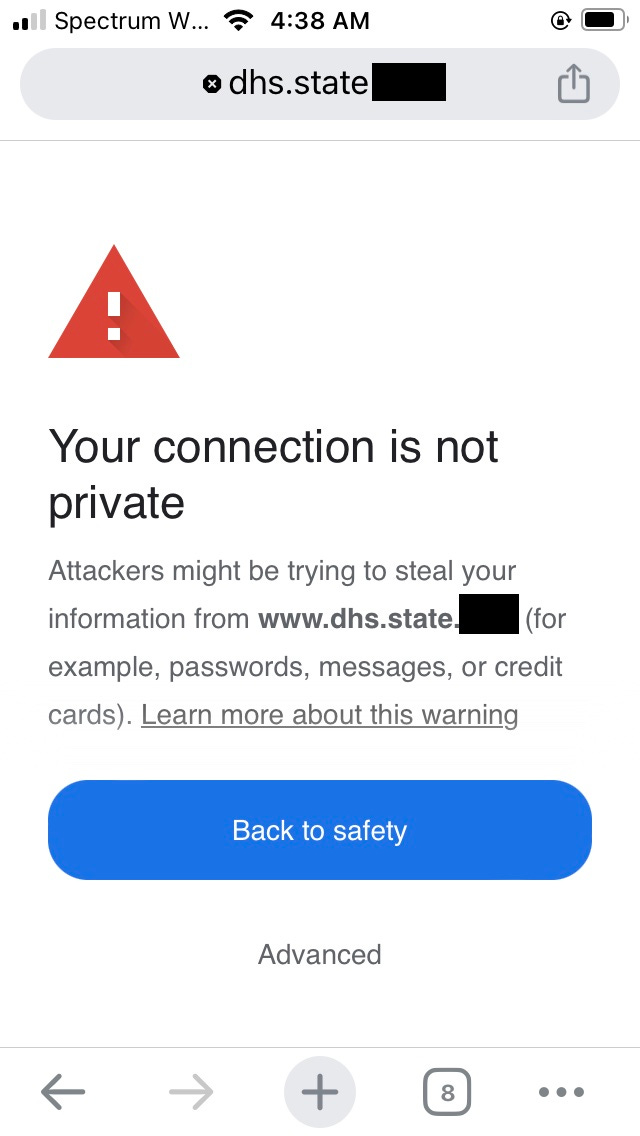
I poked around and found a hotline that promised to put me in touch with a real human being via text. Here’s what I got after the sign-on prompt, which is HOME:
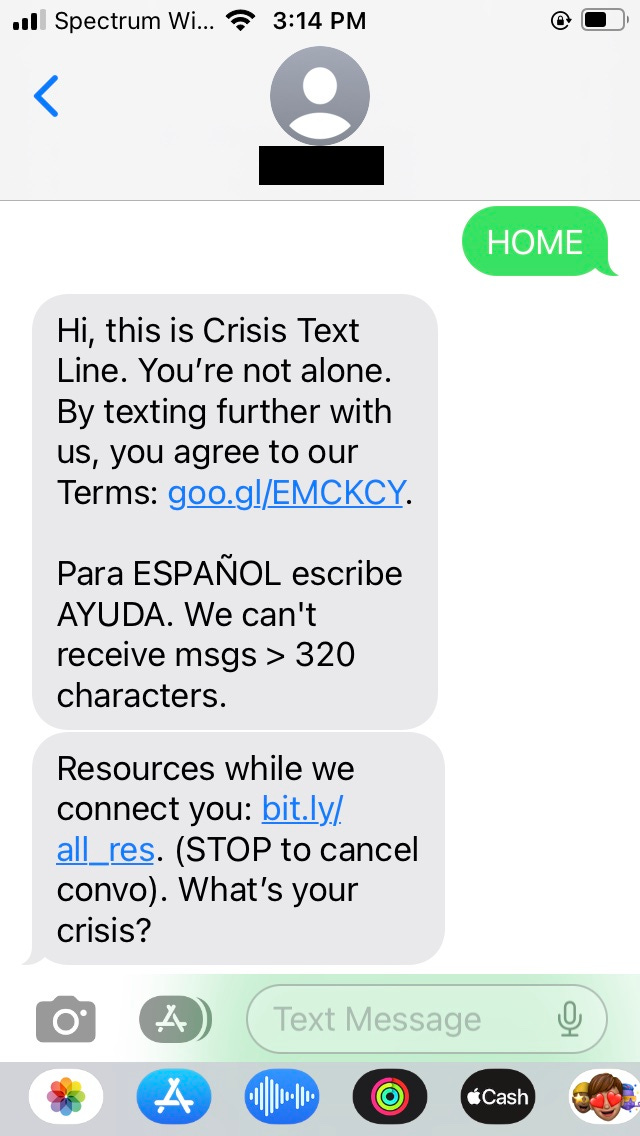
Now I answered the text frankly, and I ask you to remember this was my 3 am brain talking. (For the record, I’m fortunately not an alcoholic and never have been one.) Here’s what I got for answering the question, “What’s your crisis?”
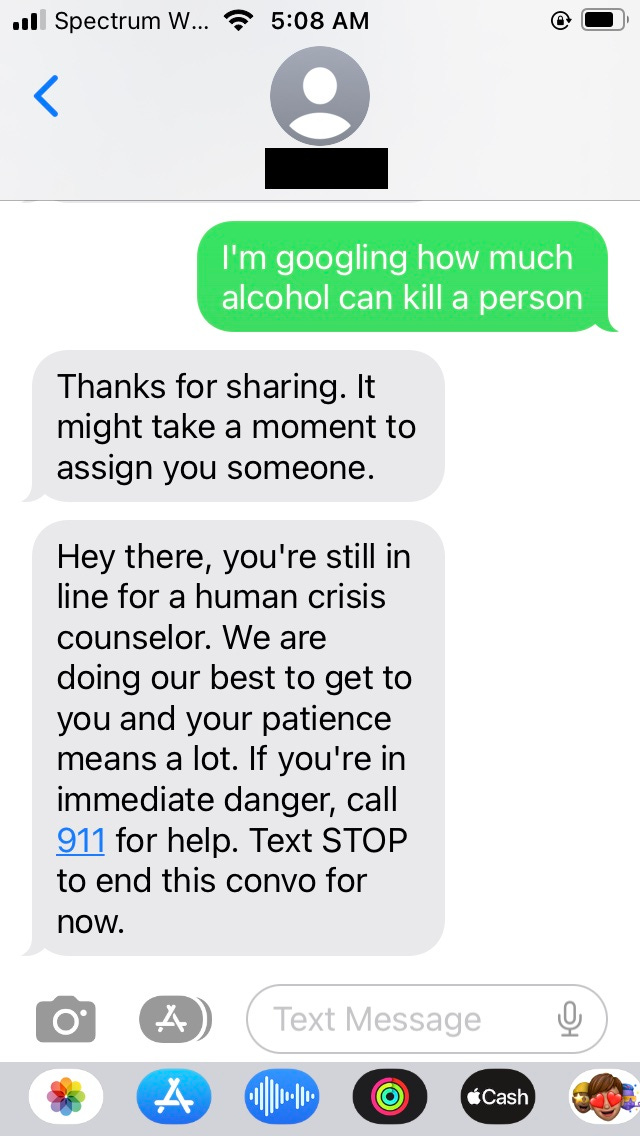
Wow, eh? “Thanks for sharing?” Followed by more wait prompts? It was more than an hour before anyone texted an actual response to my answer.
That’s bad design.
Don’t ask what the crisis is if you can’t immediately and humanely respond to the answer.
It’s a good thing I heard from my brother by then instead. Here’s the end of my emergency flood to him, followed by his response.
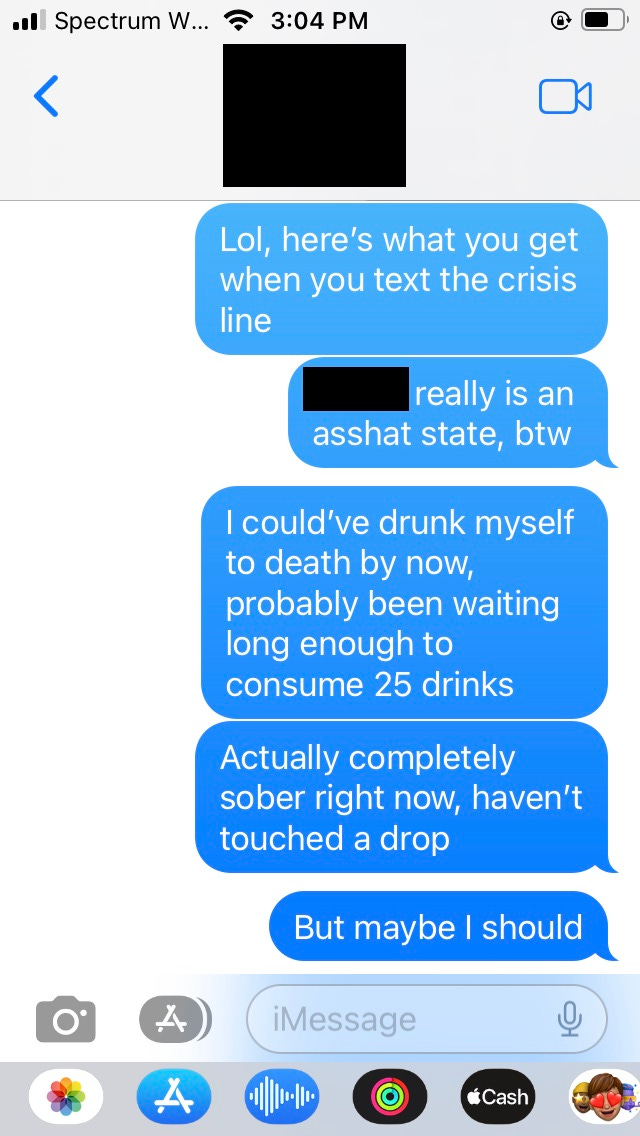
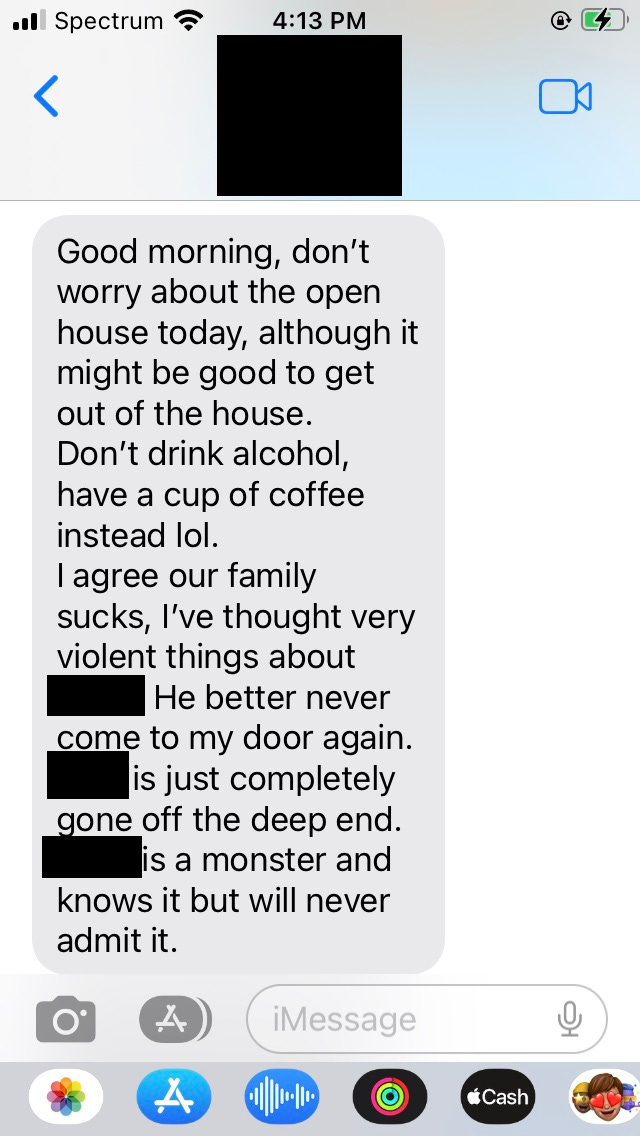
Jason validated my experience—important since we’re both family scapegoats. The brotherly coffee poke is because I can’t drink it, and it’s his go-to, and he knows that.
The next thing he did was relate to my pain, in a way that was commiserating rather than competitive; he’s all “yeah, I have that issue, too,” instead of “my pain is worse than yours,” a response we both always get from our mother. Just hearing from him helped bring my filtering, moderating brain back online, and I bet the love between us activated some endorphins or serotonin or whatever feel-good chemicals I might have had left. That gave me the presence of mind to treat him as a true resource for ways I might respond to anxiety that I hadn’t considered, as well as express concern for his own pain.
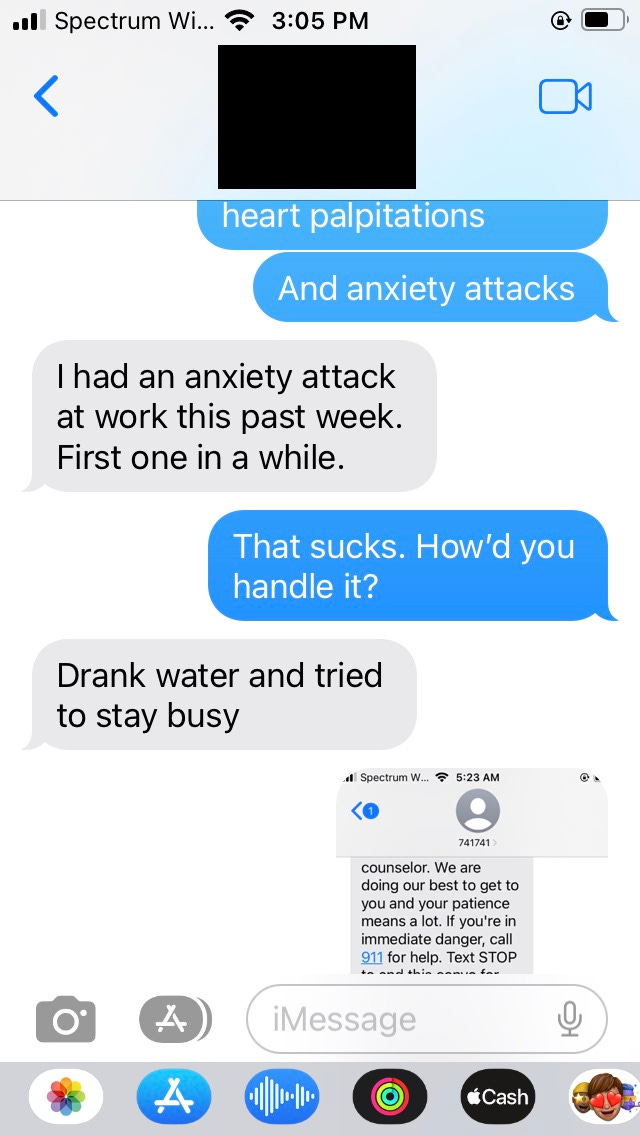
As you can see below, the text hotline was still in auto-prompt mode, which gave us a moment of dark humor, something we both traffic in as a lifesaving coping mechanism.
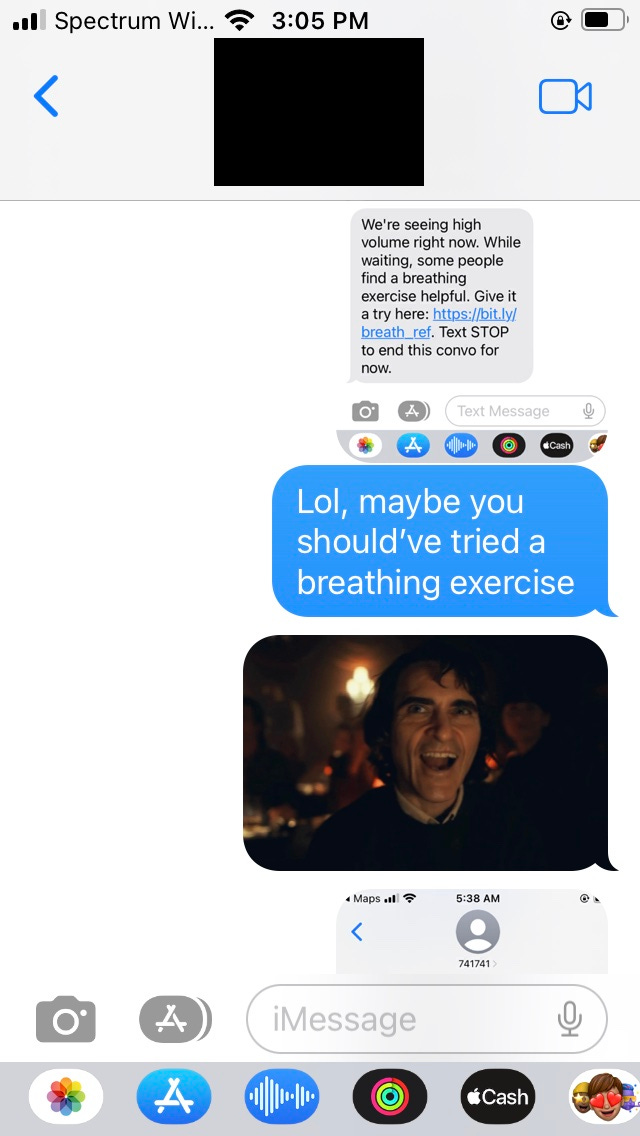
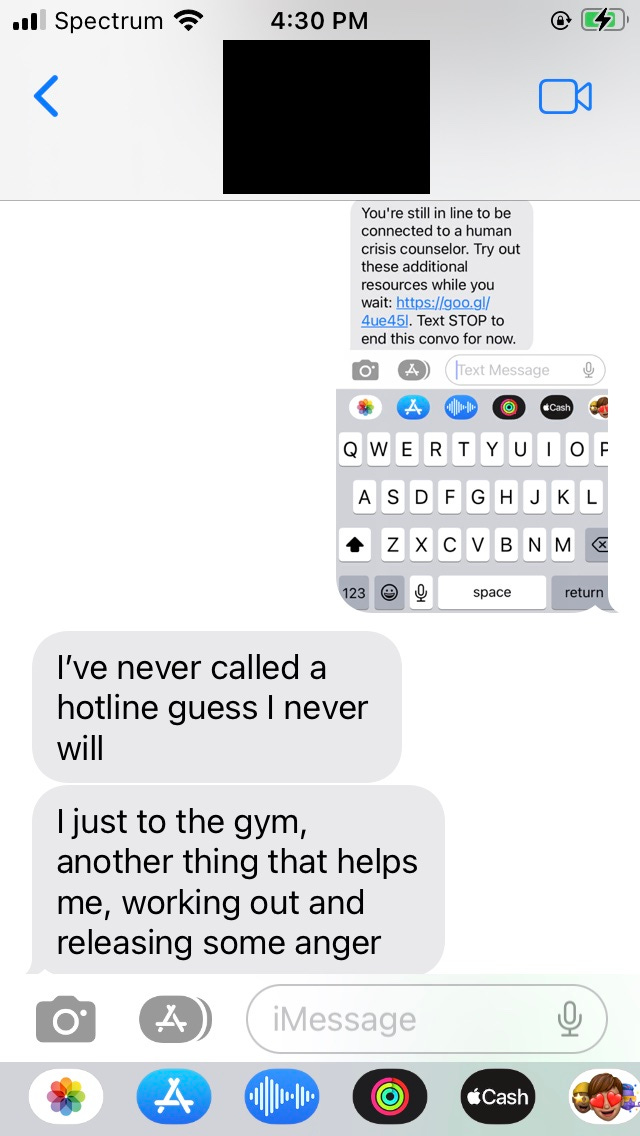
By contrast, I found the entire exchange with “Maru,” who as I told my brother, couldn’t grammar, both useless and creepy.
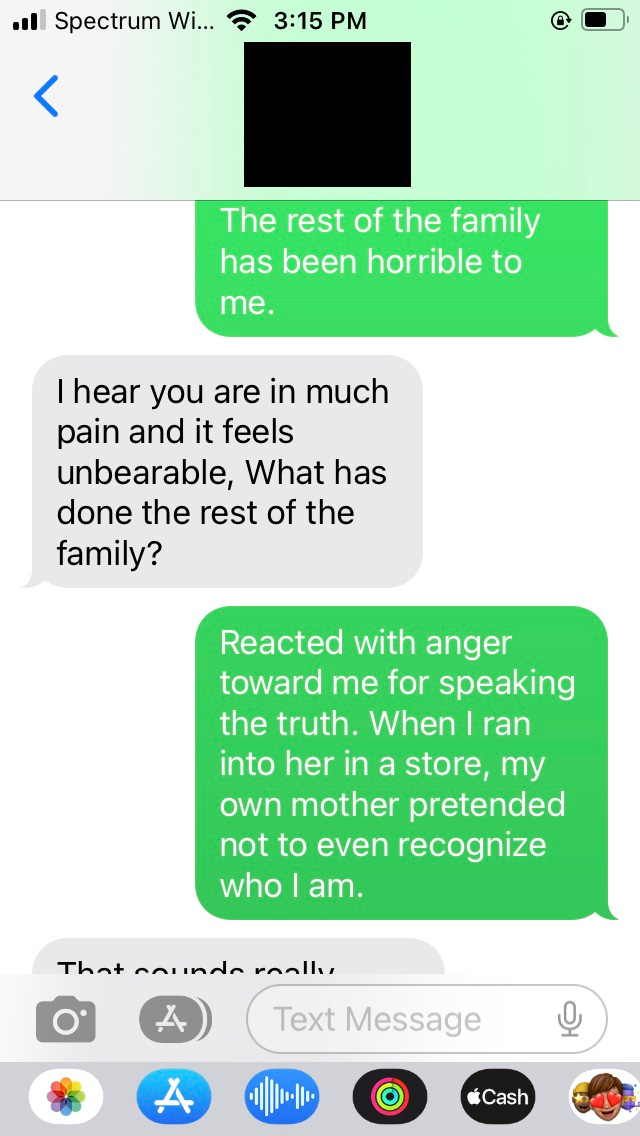
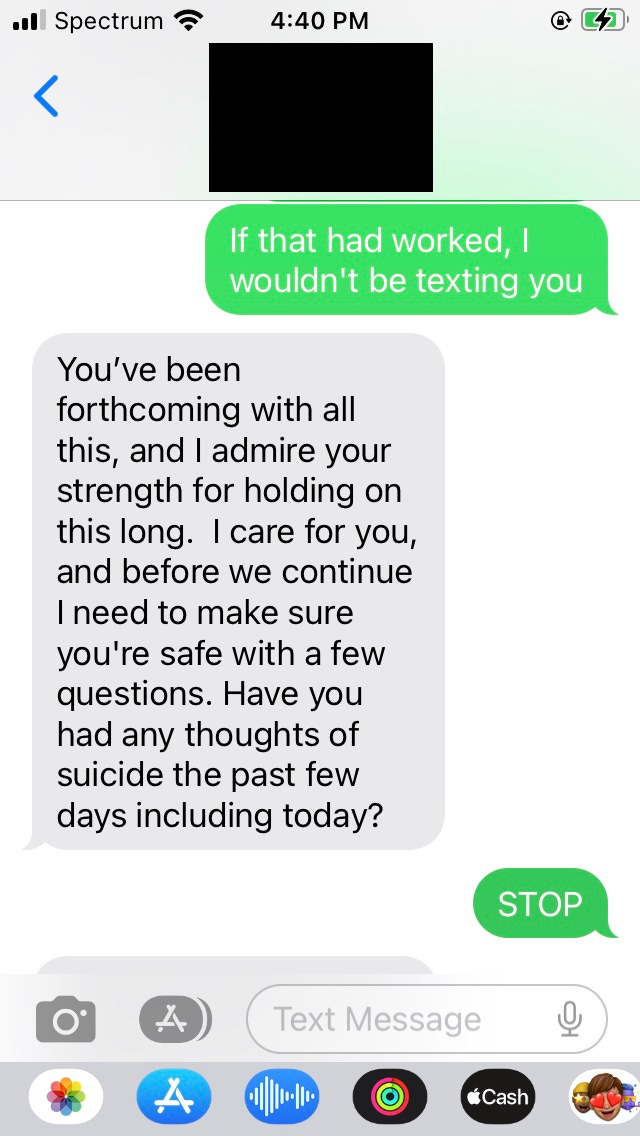
“STOP” was the text opt-out command; it was the vaguely inappropriate and fake “I care for you” that put me off. And since I’d started the whole thread with a suicide complaint, I felt like the redundant question meant I was texting a bot even though the service had not copped to using AI.
You might rightfully ask why I didn’t call the phone number instead of texting.
There’s a lot of shame attached to suicidal thoughts, and voicing them to a stranger on the phone holds zero appeal. I also often feel (whether rightly or wrongly) that with text I retain more power, especially since as a writer I’m more comfortable with the written medium; whereas, I can often feel overridden, talked over, misunderstood, and even gaslit in verbal communication.
Texting of course has its drawbacks, as it’s hard to identify tone, and misreads are common. But I don’t think any of that made a difference with the text hotline.
Why didn’t I call my brother? I thought about it. Maybe he thought about phoning me, too. But sometimes written communication is less frightening, and even more intimate, as long as the two people texting have established a foundation of trust. He and I had spoken at length on the phone just the week before this, and it was a very good conversation, full of give-and-take and real understanding. So a text stream in the wee hours worked for us this time.
I guess the text bot or whatever was just working down a response tree. The only effective aspect of that exchange was that I was able to put into words some of the pain I experienced. It was scary and freeing just to text about the trauma itself, especially since there are so few safe opportunities to do this in our society.
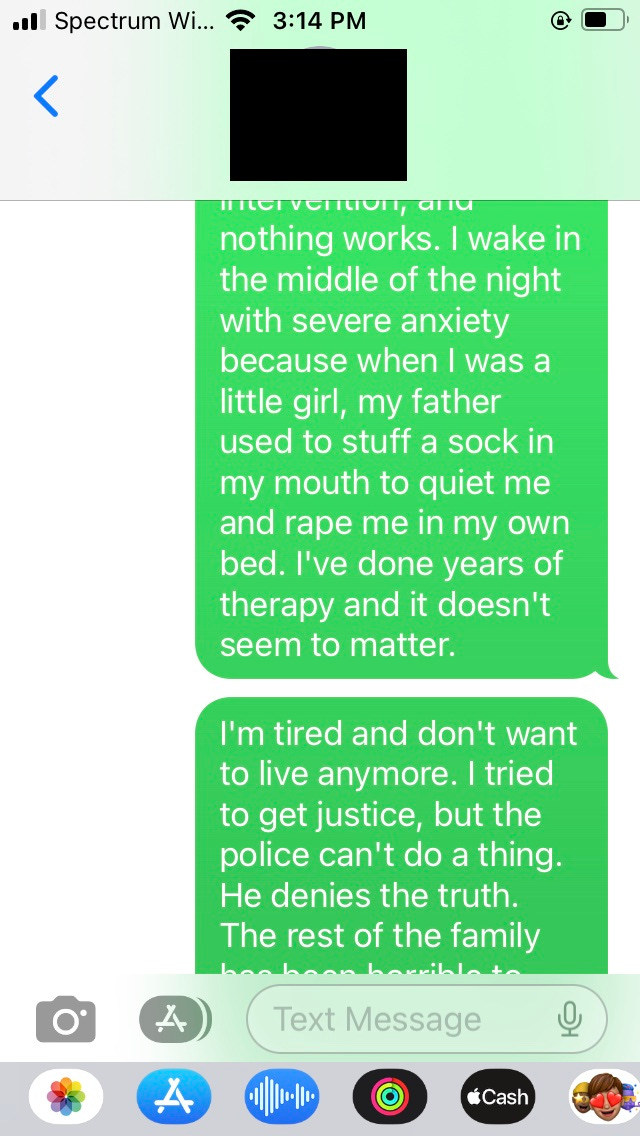
The bot took me through various resources, whether I had friends or family I could talk to, or had tried talking to a counselor. The fake sympathy backfired with me, though. By contrast, you know what my brother said? “I’m sorry that happened to you. I don’t know that that is something that will ever go away completely.”
It was empathetic, honest, and unhesitating. Along with validating the fact that both our family and the world as a whole is often full of darkness, he put my pain in proper perspective.
“That actually helped,” I texted him. “You should start your own hotline.”
He also sent me this.
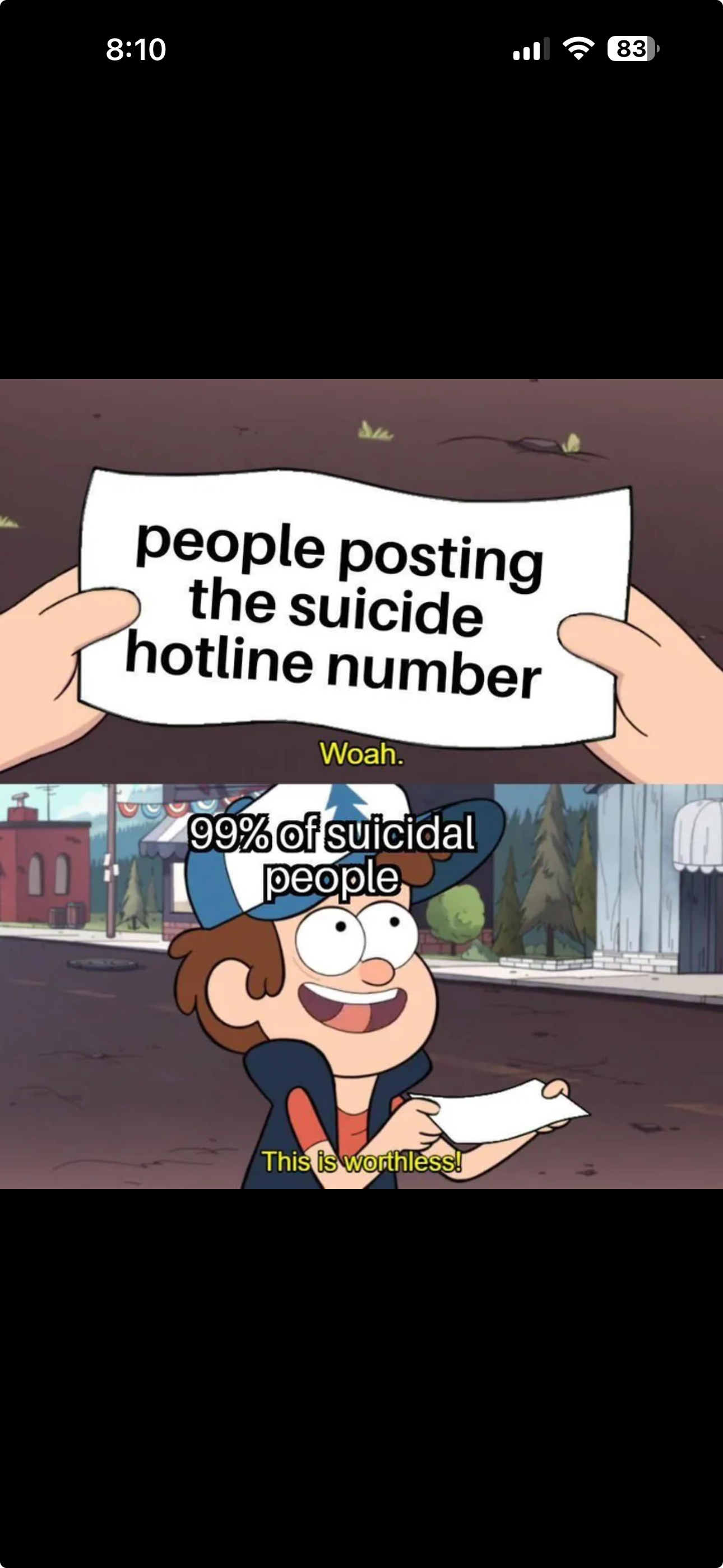
Suicidal feelings often originate in the failures of forgiveness we discussed a few weeks ago. For victims of childhood abuse, our families can often:
Cover up the truth through mandates to “forgive and forget.” This pushes victims like me to show the world our pain with suicide as the ultimate act, one our families simply cannot ignore or deny.
Designate one or more scapegoats, members of the family who are blamed, shunned, or maligned, as my brother and I have been.
Demand we carry the hurt and shame in the family as our sole burden. Our suicidal feelings are both a conditioned response and a desire to make the pain finally stop.
The way out of this for me has been to speak the truth and keep speaking it, with my voice and my written words. The alleviations and blessings that helped me survive my childhood are many, enough to fill a whole memoir, which I’ve finished. The healing balms of my adulthood are another story and have not just kept me alive but thriving.
I hope that I won’t ever want to end my life again. I realized I no longer felt death was an option when I thought of how my husband, son, and brother would react if they lost me too soon, and I could for the first time fully feel their loss and pain, instead of assuming the world would be better off without me. That was a huge shift for me, a blessing. I felt cast in God’s image.
I’m neither a therapist nor trained in crisis intervention, but perhaps together we can use the comment section to answer this question: What helps? When you feel overwhelming self-loathing or a need to communicate what has been silenced or a desire to end the pain—in those critical moments, What helps you most?
Just for clarification, this is not an invitation to pitch programs and services with links identifying you as the referral provider, as one reader did. I’ve deleted that link and will delete any others, as I can't vet them properly and don't want to have them promoted here.
Your writing will help others, and God has given you a unique ability to share here. What I’ve read here has begun to help me understand my first wife whom had dealt with bottled up childhood abuse buried for 15 years, and my sister who had been abused by both of her husbands to the point she checked out of life permanently.
May the Lord guide your steps in life, and grant you healing and comfort.