

City mouse gets a country house
It only took three decades.

For most of my adult life, I thought I’d be much better off in the city. You might blame Mary Tyler Moore.
I always wanted to be this carefree career woman, throwing her beret up into the air. Note the lead-up to that pinnacle moment shows Moore happily wandering those metropolitan streets, decidedly solitary. She might fall in line behind a group of school kids, but it’s just a temporary lark. She is herself unencumbered: child-free, single, the master of her own fate.
I thought true happiness was embodied in TV characters like hers, and so many others: Laverne & Shirley, Kate & Allie, Ann Romano on One Day at a Time, etc. Growing up in a criminally abusive home pushed me to get far away from the kinds of places where I’d lived as a kid—mostly satellite suburbs around Air Force bases. I wanted what these TV women had: rewarding careers and the freedom to live however I wished. I believed the only place to find all that was in the city.
Boy, was I wrong.
Last May my husband and I finally permanently unplugged from our perennial city moorings and moved to a rural small town.
At our old place, we’d walk down the street to a major thoroughfare overpass and an expansive strip mall. At the end of our block now is a vast farm field, the sun rising behind cornstalks on a summer’s morning.
Our former neighborhood was a 24/7 cacophony of ambulance and police sirens, constant steel crashing and creaking from the nearby intermodal station, and the guttural burp and moan of a major highway within glancing distance. Now we hear mostly quiet, but for the occasional barking dog or sounds of children at play.
This was a very good move for us and the culmination of a long transition out of our urban lifestyles to something actually better.
And it only took our entire adult lives to make it!
He’s no different than I am, my husband. I sought solace in Seattle and St. Louis while he poked around for the good life in Portland and San Francisco. He’d grown up in the smallish farming burg of Walla Walla (before the wine industry changed it) but left as soon as he could. Our friends, too, no matter whether we met them in the small towns where we went to high school or along the way, all ended up in metropolises: D.C., Chicago, L.A., New York.
It’s strange, isn’t it? This belief that city life trumps country life.
I finally did get it all, you know. The whole Mary Tyler Moore package. I remember the distinct moment I’d arrived.
By 2009, I lived in the top floor of an apartment building in Seattle, a nice place with a corner balcony—and for a time, at least, until new development blocked it—a view of the Olympic mountain range peeking above the hospital next door. I could walk to a 5-star sushi restaurant, a hot yoga studio, and a legendary music venue showcasing awesome new bands—before they went megafamous and were therefore still hip. I was single and would meet my other single friends at a bar where we’d order complex drinks with clever names like a ‘Judy Blooming’ with chamomile-infused vermouth and a laphroaig rinse.
For someone like me whose childhood trauma casts a long, dark shadow, this lifestyle seemed like a great victory. I wasn’t ever supposed to be successful, independent, financially secure, or even so much as healthy. My destiny should have been miserable failure. My primary function as a child had been to be used—by my father for his own perverse gratification and by my mother for her own gaping emotional needs.
But by then I’d completed years of psychotherapy and other interventions to reckon with recurring nightmares and sleep disturbances, negative beliefs, self-doubt, self-loathing, and a full range of medical conditions I now know are rooted in that early-life trauma. I’d also just ended an eleven-year marriage to a musician and artist who hadn’t wanted children; he just wasn’t into the idea of being a father—or a provider. Ours was a sometimes-healthy, often-not-healthy relationship—until it no longer was at all.
As a born-again single lady, I’d found good work funneling a talent for writing into something that actually paid for a change and began to dig out of the debt I still carried from years of low earnings and marriage to a downwardly mobile artiste. I’d assembled a group of girlfriends, of like mind in our appreciation for a certain brand of middle-aged urban sarcasm. I was out to enjoy everything Seattle had to offer.
I even wore a beret nearly every day, a black one that covered my ears, necessary gear in a city where it rains for nine months of the year. There’s a reason Seattle is synonymous with coffee!
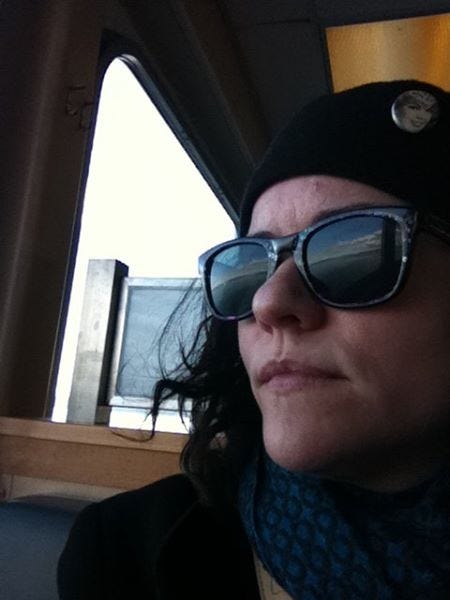
But urban amusements can only get you so far. Even the most supposedly life-altering experiences—like that epicurean delight I imbibed at Canlis or the thrill of dancing along with David Byrne by the waters of Puget Sound—left me feeling a bit… empty?
Part of this was plain loneliness. There were long stretches when my friends were too busy with their own lives, and even in their company I’d feel it creep up. The loneliness came in waves of longing as I’d sit in a dark movie theater eating popcorn for dinner and watching children’s animated movies—not because I had kids of my own but for research, as I was gainfully employed writing stories for the video games they play.
That’s a sad thing to do, create games for kids you do not have.
You see, after all those years of mental health and somatic work, I could finally hear my biological clock, and it ticked loudly. But there I’d been, married to a man who was sort of like a child himself, such that I was the breadwinner and chief person of responsibility. I did want children—just not with him.
I was 37 when we parted. The window was closing fast. I at least knew better than to think that I could find the right person lickety-split for an insta-family, so I kept the pressure off the whole post-divorce dating thing to see what casually unfolded.
In the alterna-city of Seattle in 2009, what casually unfolded was a whole lot of nothing.
One guy flat-out told me he would not have children with a woman in her late 30s due to the risk that the child would be born with Down syndrome. As much as his declaration sucked to hear, it was valid: According to the The Menopause Society, children born to mothers older than 35 are more likely to have genetic disorders1.
Most other guys I dated were allergic to the very idea of children. I might as well have said I was a Christian and wanted us to go to church!
It was a long haul, that round of dating, with breaks in between to regroup. I learned a lot about myself, what my values were and what kind of relationship I desired, listing these in my journal. I approached dating in a much more conscious way this time than when I’d simply fallen for a mandolin player in a stairwell back in 1996.
Intention is everything. It seems to me that when you put something like this out there, the universe or God or whatever will listen. It just might not be literally what you asked for.
“Soon the ones you’re supposed to make a family with will be here,” a voice seemed to say. I felt their presence as a premonition. I actually heard the sound of their male laughter and talk reverberating through my large, sparsely furnished apartment before they even showed up.
Anthony and Zander.
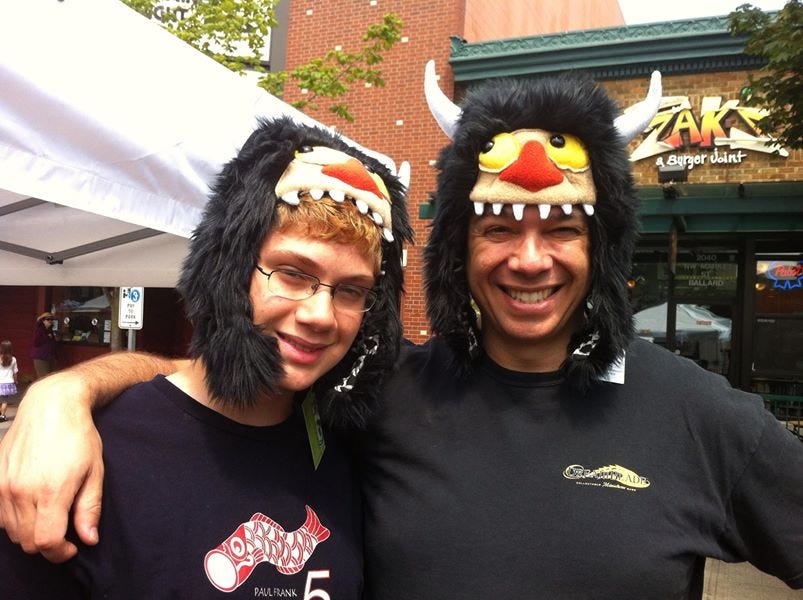
What a pair! Anthony still had some growing up to do, but so did I. We thrilled to the size and shape of the luggage we brought into the relationship and then tried not to wince when we saw all of what was inside. The kid was eleven-going-on-eighteen and awkwardly tried to put the moves on me during our second family date.
“I’m pretty sure you’re going to break up with my dad and go out with me,” he announced.
“I’m sure that’s never going to happen,” I countered. “I’ll be sort of like a mother to you, but since you already have one of those, I’ll be another woman in your life you can think of in that way.”
That’s all it took. To set a healthy boundary. To draw the right expectation. To set the tone for our relationship.
Zander wasn’t actually trying to put the moves on me. He was testing the line, and as soon as I showed him where it was, he looked relieved, our relationship thereby established.
By comparison, I didn’t see this same move in one of Anthony’s longtime friends. My stepson tried the same ploy with her, and the woman actually flirted back. But hey, she drinks coffee like a long-haul trucker and prefers that look in her ladies as well, so no harm done, right?
Anthony, Zander, and I traipsed around Seattle and the Pacific Northwest, mining what they call “God’s country” for what we could do together as a family. From the jump, I liked to give the kid experiences that were rarer for Seattle, like setting off real fireworks or making popcorn in a pot instead of the microwave. His dad and I took Zander to his first concert (Alt-J before they got famous) and to a course on proper gun safety—idolizing rap stars, he’d become obsessed with gangsta gear. That last one might’ve saved his life, which is a story for another day, and his to tell.
We always made it a point to sit down together for dinner as a family.
When I weigh my own success as a stepmother, I see all of the above on the plus side, as distinctly my ideas and influence. Among other mistakes on the negative side, I often see this image: my two guys sitting in the lobby at Big Fish Games, waiting for me to get off work.
I wish now I had that time back.
But all the work? It paid off my hefty student loans and helped me and Anthony finally buy a house—just not in Seattle, and not so we could fill it with more awesome kids like Z.
Turning 40 the year we met, with Anthony at 47 and not inclined at that age toward another round of fatherhood, I had to let go of the dream of holding my own baby in my arms.
It’s a tragedy, a loss. I’ve written before about this milestone of getting to menopause and mourning the baby you never had.

We’d have made excellent parents and did, with Zander. One of our credits was to get him out of Seattle just when he needed it most, and not just once but twice.
Despite my tech gig and his father’s post-2008-crash rebound role as a grant administrator, we could not afford to buy a house in the Emerald City. The two of us were working our asses off in middle age, but home ownership meant taking on an enormous burden, and retirement looked impossible either way.
What’s more: Anthony and I both individually and then as a team saw where Seattle was heading, and it wasn’t good.
Anthony had predicted the 2008 crash, and being right about that cast other presumptions into question. I noticed that our own Generation X wasn’t doing as well on average as our parents’ generation, and the shift traced back to the very year of my birth, as exemplified by a sobering, illuminating collection of graphs to illustrate the point called WTF Happened In 1971?
I started this Substack back in 2022 with a whole breakdown of the limits to growth behind our civilizational decline in a series called Slowpocalypse, and that’s part of the picture for us. Seattle had changed dramatically in the decade we’d called it home, and not for the better. It was more dangerous, more expensive, and much less diverse, ideologically speaking, in 2015 than it had been in 2005.
Six months after our wedding, we left.
Here’s the love letter I wrote to say goodbye to the city I’d lived in and loved in for a decade.

Where did we go?
We moved to a small town.
That’s right.
We’ve done this before!
It just didn’t… fully take that first time.
We’re both a bit thickheaded when it comes to the urban lifestyle myth. Call it a symptom of Generation X.
I’ll pick up here next time.
By the way, I recently mentioned removing a reader comment, and I now regret that decision, as discussed in the chat. What do you think?
If you liked this post, you might also enjoy my award-winning mystery series set in Seattle, about a family of detectives who solve crime using their ability to slip into other people’s dreams…


The Menopause Society. “Symptoms: Decline in Fertility.” 22 Jan. 2026. <https://menopause.org/patient-education/menopause-topics/symptoms>.
You tell your story so wonderfully. I'm glad you managed to make a happy life.
Happy country living!
I hope that spring peepers are audible around your new domicile. Or maybe you'll have some other, cool harbinger of Spring.
(The frogs are due here at weedom in 3 weeks, though we have lots of snow cover still.)