

Brain retraining in the garden
It was all yellow.

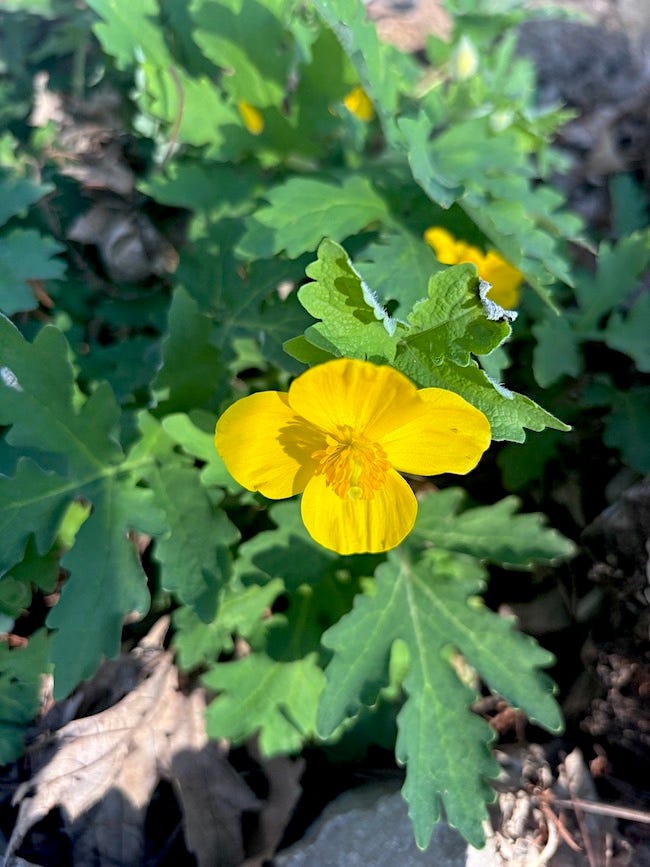
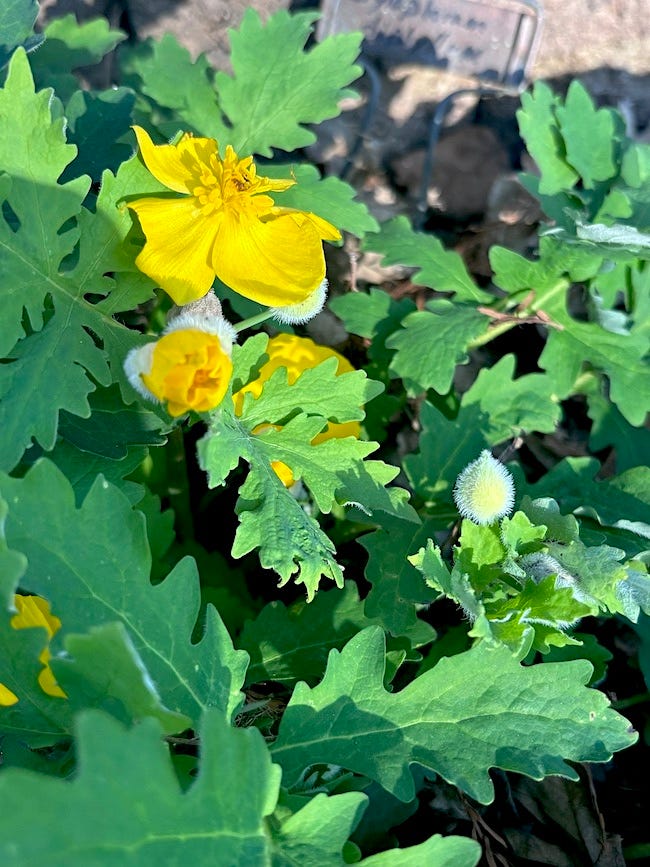
Last week’s post might’ve been hard for you; suicide is a rough topic. Here’s a celandine poppy for a visual refresh. In my pledge to readers, I promised to give beauty its due, so let me fulfill that promise.
This remarkable native blossom is one of my transplant success stories.
After a cold, dark winter, our eyes thrill to see the warm, sunny yellows of springtime.
Longtime readers know I can get a bit daffy about daffodils. As I said in this piece chronicling our former garden, they “put me back into that mode of feeling a rare joy to see them as winter gives way to spring.”

When this spring came, and I realized there wasn’t a single daffodil on our new .33-acre property, I felt the lack.
I’m not a naturally optimistic person; I have to work at it. That’s not exactly my fault, as trauma created a negative feedback loop that tends to flood my system with epinephrine—causing anxiety—and cortisol, which can make me grumpy or even angry. Survivors of serious trauma aren’t being stupid or stubborn when we seem to delve too quickly into the negative. We’re fighting ingrained neural pathways that trigger powerful chemicals.
And fight them, we can do. While I’m not to blame for the easy fall into grey-sky thinking, I don’t have to live that way. What I’ve learned after two solid years of brain retraining is that we can interrupt the negative feedback loops and create new pathways.
Sometimes all it takes is to notice and reframe.
That celandine poppy gave me the sunny boost I needed. I’d uprooted it as a transplant division last May when we moved and hoped it would take to the new location. I was pleasantly surprised to see that it had.
I can look at it from my new home-office window, shining there like a beacon under a bald cypress tree.
Celandine poppy is such a vibrant saffron that Native Americans used it as a dye1.
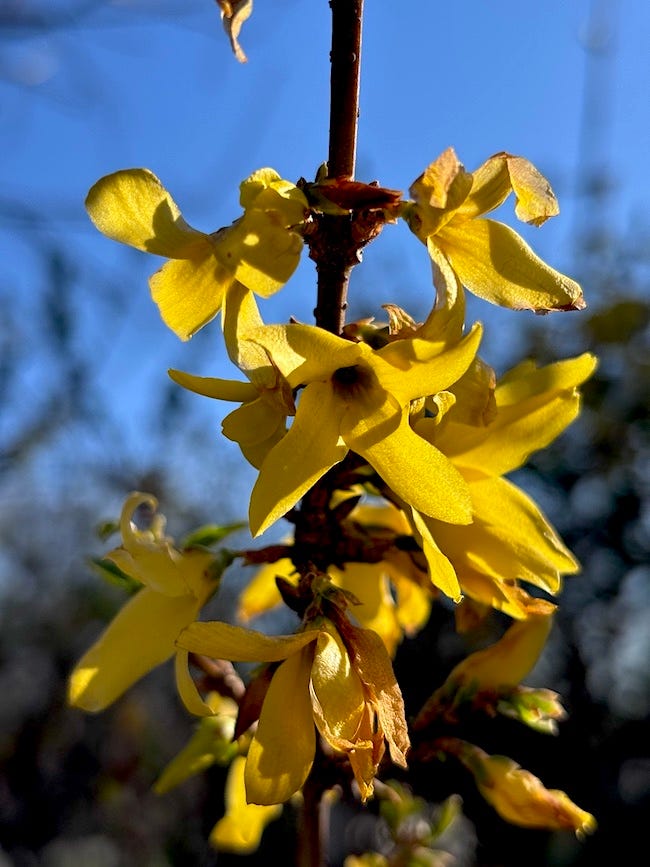
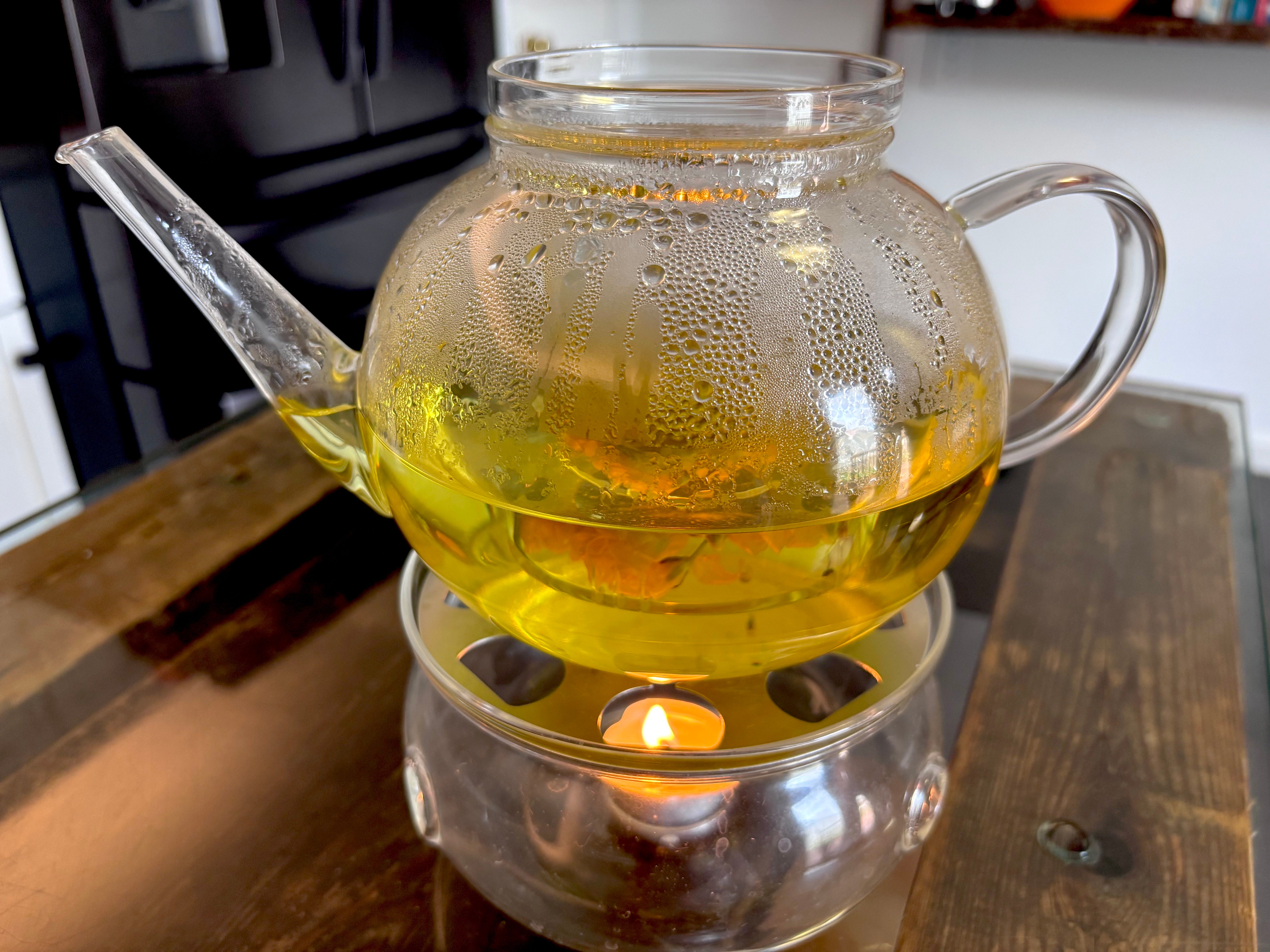
A bush I hadn’t been able to positively ID last summer burst forth with unmistakeable flowers the same week Anne Stobart explained how you could use forsythia petals in a fragrant, cold-busting tea. That sealed it: I have a thriving forsythia! To hit the coincidence with a third note, my husband had a cold, so I made him Anne’s tea.
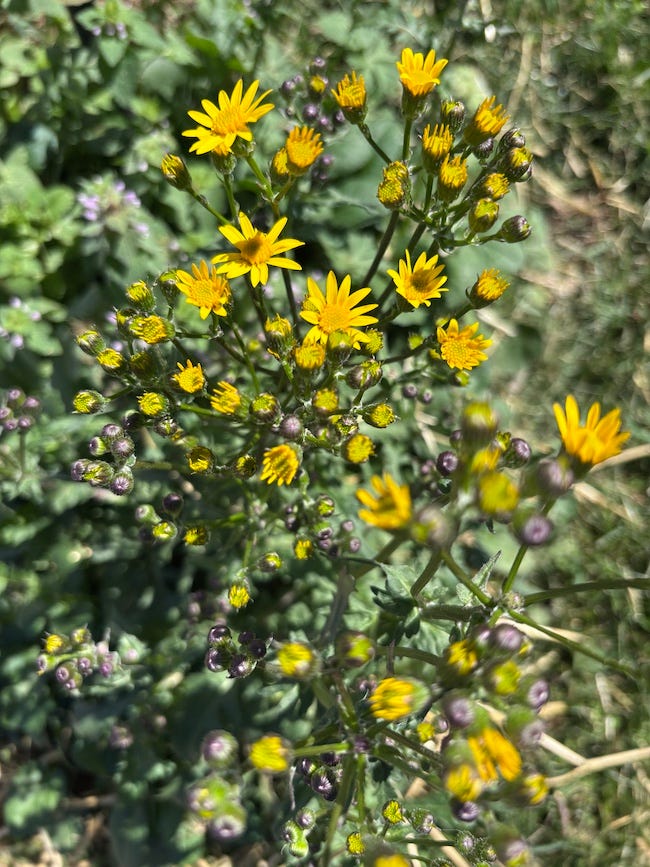
My other successfully overwintered transplant: golden groundsel or Packera obovata. The jaunty little beauts emerge early and stick around all spring and summer, sending cheery yellow flowers up short stalks.
I felt much better once I noticed these three yellow blooms, allowing me to reframe the dearth of daffodils around a plethora of petals instead. Besides, I now have an excuse to pore over bulb catalogs for all those fancy daffodils I didn’t have room for in the old garden. You see, I really have to work to convince myself.
What I’ve done here is essentially a brain-retraining exercise. To recap:
First, I became aware of my negative thought pattern: oh, woe is me, no daffodils
Then I halted the thoughts: whoa, am I really self-pitying over daffodils?!
Next I questioned and reframed the narrative around them: missing the old garden and feeling the loss of it became the spark of a clean slate and new opportunity for beauty
Finally, I realized what I had and celebrated it: three bonny blooms like sunbursts
But I don’t want you to think it’s always this easy, or that this was just about flowers.
It never is, right?
All of my petal drama was a big, juicy stand-in for the loss of family and friends over the past two years, people who couldn’t come with me as I changed for the better, shedding old patterns, bad dynamics, and unhealthy coping mechanisms.
These were people who demanded I stay put, stuck, complying with their conditions for love or friendship, going along with their lack of boundaries, or upholding their demonstrably false narratives. They punished me when I refused, with first ill treatment and then outright rejection when that didn’t work.
It can be so hard to turn against all those unhealthy demands and expectations with people you love. You might even revert to them again without knowing, like a record needle stuck in a groove.
I’m a sap for some Coldplay, especially this apt song featuring the color in question.
For years “Yellow” was a repeat in my workplace playlists. I’d sit in my office pod, my ears nestled in noise-canceling headphones, gazing out at the watery deep of Puget Sound under gun-metal grey skies… while feeling mostly melancholy.
I thought the song only confirmed my gloom. I told myself it was about a guy who loved a super-skinny girl, as most of them do, of course, right? “You’re skin and bones/ set into something beautiful,” is how I heard it.
I’ve never been a super-skinny girl, and I used this as a way to feel bad about that.
I did have some help—from a mother who literally stuck a picture of Twiggy on our refrigerator for diet motivation. Also the guy who told me, “Did I hear you say you’re trying to slim down? What a great trend for you!” And two different guys I dated who flat-out stated they preferred “slender Asian women.”
The truth is, I’ve usually been average. Not underweight. But not overweight either.
The other truth—which I didn’t realize until I looked up the lyrics for this post—is that I got the song all wrong: It’s not “you’re skin and bones” but “your skin and bones.”
I used to teach the difference between you’re and your to underprepared college students. There are many examples of how correct grammar can save lives, and this is one more.
It’s a sweet song, actually:
I wrote a song for you
And all the things you do
And it was called, “Yellow”So, then I took my turn
Oh, what a thing to have done
And it was all yellowyour skin, oh yeah, your skin, and bones
(Ooh) turn into something beautiful
(Ah) and you know, you know I love you so
You know I love you so
Those Coldplay guys weren’t fetishizing some anorexic chick like I cynically thought. Sometimes when we’re conditioned toward a negative outlook, we’ll see evidence to support that outlook even when it’s not really there.
That’s why repeating the brain-retraining steps is so necessary.
You can’t just “put on a happy face” or “give it a positive spin.”
It takes consistency, commitment, and most of all, repetition to ignore a well-worn groove and press into a new one. Those four steps above? Imagine you have seven of them total2, and you’re running through them about 50 times a day, with a lot of painful truths about where these negative thoughts came from in the first place surfacing for you to process and reframe as you go.
Brain-retraining—and the other work it prompted me to do—was harder than psychotherapy ever was, harder than the punishing 104° hot-yoga sessions I used to power through, harder than my divorce or having to lay off all of my employees or moving across country not once but several times.
But the most difficult challenges can give you the best results.
I’ve had to work through the stages of grief and am still working through them now, grieving the death of a child part of me and the death of the wish that my birth family could be made whole and the death of my own biological motherhood.
If I frame this in terms of faith, even going back to those 10 commandments these days most of us ignore, I can see that focusing on what you don’t have can easily push you into coveting what others possess. Social media platforms monetize mainly on that principle, making you compare yourself to others, feel your lack, and then envy your friends and influencers. That way you’re ripe for whatever advertisement the algorithm has targeted you to receive.
Simply practicing gratitude is a good way to counter all that, as it reframes just as I did in the garden. Instead of self-pitying over a dearth of daffodils, we revel in forsythia flowers, celandine poppies, and golden groundsel.
While it’s important for me to express the grief I feel over the loss of those friends and family who rejected the healthier me, I don’t want to stay in grief mode forever. I can look at those bonds that not only survived my changes but grew even stronger through the process, and to the new friends I’m making along the way, people who understand because they’ve been there, too.
My celandine poppy didn’t just survive the transplanting to the new home. It’s doing much better here. The conditions in the new garden are more suited to its needs.
Stylophorum diphyllum. Missouri Botanical Garden Plant Finder. 25 March 2026. <https://www.missouribotanicalgarden.org/PlantFinder/PlantFinderDetails.aspx?kempercode=m450>.
The brain-retraining techniques I’m describing here were inspired by the Gupta Program. I now receive a small commission for every referral through that link, at no extra cost to you. For more information, see what I’ve written about the program in past posts.
What's the hardest thing you've ever done to heal?
Hope you grow into it like your poppies.